


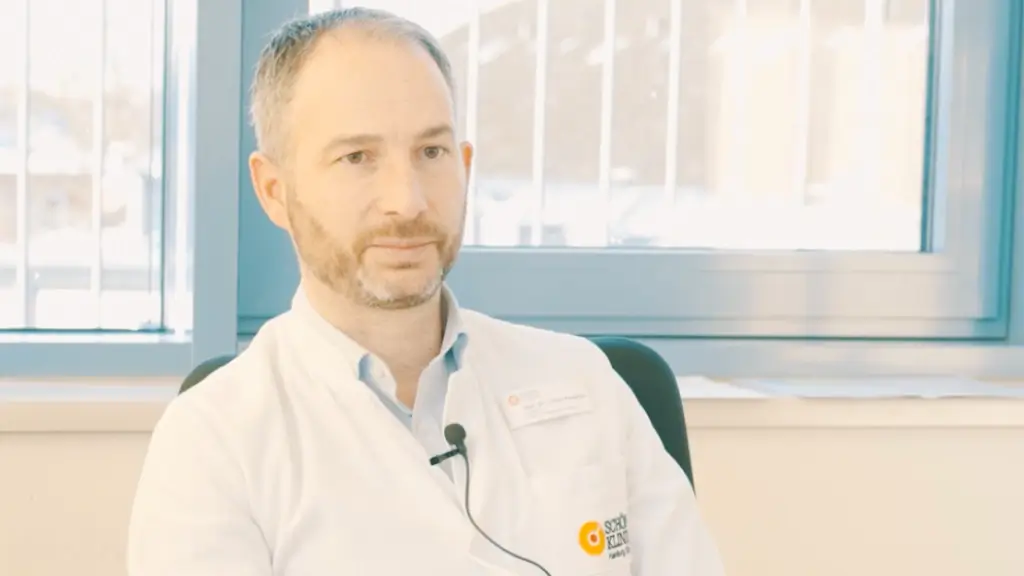
Prof. Dr. med. Volker Fendrich is a leading specialist in endocrine surgery and heads the largest Endocrine Surgery Center in Germany. Last year, nearly 2,700 procedures for endocrine disorders were performed there. He personally performs 500-700 surgeries per year.
Prof. Dr. Volker Fendrich prioritizes patient care above all else. He practices at the Schoen Clinic Hamburg Eilbek where he serves as the Medical Director and Head Physician of the Department of Endocrine Surgery.
In the interview, he discusses the fundamental differences between thyroid surgery and other types of surgery, the key challenges and goals of endocrine surgery as a whole, why robotic procedures offer little benefit in this field, and how his diagnostic approach helps to avoid unnecessary surgery.
Prof. Fendrich, thank you very much for agreeing to this interview! We are very happy to meet you! Could you please introduce yourself?
My name is Volker Fendrich. I am 51 years old. I work at the Schoen Clinic Hamburg Eilbek. I have been the Head Physician of the Department of Endocrine Surgery since 2017, and I have also served as the Medical Director of the clinic since 2020. Prior to that, I worked at the University Hospital Marburg for 17 years, where I practiced in various surgical specialties. Endocrine surgery, which deals with the treatment of diseases of the thyroid gland, parathyroid glands, adrenal glands, and neuroendocrine tumors became my specialty at the Schoen Clinic Hamburg Eilbek.
Since last year, we have been the largest Endocrine Surgery Center in Germany. Last year, our department performed almost 2,700 operations for endocrine diseases. For comparison, there is only one other such clinic in our country that performed 2,500 such operations over the same period of time, and many university hospitals perform only 100-150 such operations per year.
So endocrine surgery is our area of expertise. As of this year, we have at our disposal three operating rooms where we perform surgical procedures for endocrine diseases every day. This is certainly unique in Germany. I personally perform 500-700 operations per year. We are also the leading clinic in northern Germany, specializing in the surgical treatment of adrenal diseases and, of course, thyroid and parathyroid pathologies, the latter being the most common. They say that our department performs the most operations on the parathyroid glands in all of Europe. Of course, these are just words, because there is no concrete data, but if they say so, it is for a reason.
What are the latest advances in the field of endocrine surgery?
Over the last century, little has changed in the field of endocrine surgery: 99.9% of thyroid surgeries are still performed through the so-called collar incision on the anterior surface of the neck, although the size of the incision has, of course, decreased relatively. Minimally invasive operations on the thyroid gland have not entered into practice, so, from a technical point of view, the main achievement is considered to be the emergence of intraoperative neuromonitoring systems.
Such devices are used for imaging and preservation of the integrity of the recurrent laryngeal nerve during surgical procedures on the thyroid gland. This is one of the main tasks of the surgeon, along with the surgical removal of the thyroid gland. This type of surgery should be performed in specialized clinics because its success depends largely on the experience of the surgeon.
Can patients suspected of having an endocrine disorder undergo a comprehensive examination at the Schoen Clinic Hamburg Eilbek? If yes, how long does it take?
It is not a problem for us to conduct a comprehensive examination, and we willingly do it, although some patients come to us on the referral of their attending physician with an already established diagnosis. Nevertheless, many patients come to us for further examination and start with diagnostics after the general practitioner identifies thyroid nodules on ultrasound scans.
Diagnostic procedures are performed in our own outpatient clinic and take only 2-3 hours, so everything is done as quickly as possible. If a patient needs a fine-needle aspiration biopsy of a suspicious thyroid nodule, we will get its results within 24 hours. The final diagnostic stage is thyroid scintigraphy, and indeed the final diagnosis is made within 24 hours.
What surgical procedures can be performed for endocrine diseases at the Schoen Clinic Hamburg Eilbek?
We perform 2,700 operations annually, of which about 2,100 are operations on the thyroid gland, 400-500 are operations on the parathyroid glands, and about 50-60 are operations on the adrenal glands. The rest of the surgical procedures are for neuroendocrine tumors, and this group also includes neck lymph node removals, which do not fall under endocrine surgery. Thus, the majority of operations are, of course, performed for thyroid and parathyroid pathologies.
Neuroendocrine tumors are extremely rare. It is actually one case in a million. It is therefore quite logical that we rarely perform operations to remove such tumors, but as for operations on the adrenal glands, we perform 50-60 such interventions and are among the top ten medical facilities in this field in Germany and among the top three in northern Germany.
What difficulties may arise when performing surgery for endocrine diseases?
When it comes to thyroid surgery, the main problem is that there are too many of these procedures performed in Germany. We, therefore, examine every patient who comes to us and try to avoid surgery whenever possible. Given the fact that we perform the largest number of thyroid operations in Germany, this may sound paradoxical. The fact is that many patients choose to undergo treatment in our department precisely because they are well aware of our extreme caution in this matter. The conversion rate in the outpatient clinic of our Department of Endocrine Surgery is around 60%, which means that 40% of the patients return home without any indications for surgery. This is of crucial importance for us.
There is now an increasing incidence of nodular goiter in Germany. According to statistics, about 50% of the population at my age already suffers from nodular goiter, and among patients aged 80 years, this figure reaches 70-80%. Of course, most cases of nodular goiter in these patient groups are benign changes and are not life-threatening, but it is extremely important to identify suspicious thyroid nodules, including those that are visible to the naked eye and cause local symptoms, and offer the patient an appropriate surgical procedure. Our goal is to preserve one lobe of the thyroid gland if possible, because in this case, the patient will not need to take hormonal drugs for life. Of course, everything depends on the specific case.
When treating patients with adrenal gland disorders, we always work closely with endocrinologists because the detection of a hormone-producing tumor requires special laboratory diagnostics, and the surgeon can only perform an operation to remove the affected adrenal gland. Such interventions are performed using minimally invasive techniques through three small incisions, and a hospital stay after them is only 2 days, almost like after thyroid surgery.
What is the role of robotic technology in modern endocrine surgery?
At the University Hospital of Marburg, where I used to work, they were trying to develop a robotic technique for thyroid gland removal with an approach through the axilla, which would make it possible to avoid postoperative scars on the neck. Let me put it this way: it is technically possible to perform such an operation, but it is inappropriate because it takes 5-6 times longer and, accordingly, its cost will also be 5-6 times higher.
In addition, the only advantage of this type of surgery is the cosmetic outcome, and many patients simply do not need it. And the surgical technique itself is almost comparable to "jewelry work", if I may say so, because the surgeon has to get step by step from the axilla to the thyroid gland through the muscle tissue. It turns out that the robotic system is a kind of "high-tech toy" in the hands of the surgeon, so to speak.
Robot-assisted thyroid surgery is therefore not yet widespread. Of course, at the patient's request, he or she can be operated on not with the use of classical minimally invasive techniques, but with the help of robotic technology. Studies have been carried out in Sweden, and they have not revealed any advantages of such operations. Of course, there are no disadvantages either, but in this case, the decisive factor is still the cost of the operation.
What countries do patients come to you from?
Most patients with thyroid cancer come to us from Eastern European countries, and the further east you go, the higher the risk of cancer due to the Chernobyl accident. Now the situation is gradually changing, and the current generation of children in these states no longer has an increased risk of cancer. Once a year, children from Ukraine come to us for thyroid gland examinations, and for the last 6-7 years, not a single case of cancer has been detected. In the past, most children were diagnosed with cancer, but now things are different. However, the prevalence of thyroid cancer in Russia, Ukraine, Belarus, and other countries in that part of Europe is still quite high, so most patients come to us from there.
We also always have many patients from Scandinavian countries. These countries are located not far from Germany and have terribly long waiting lists for surgery. The world's largest clinic specializing in thyroid surgery, along with ours, is in Tampa Bay, Florida. They have a special interactive map that tracks where patients come to them from. So it's even scary to imagine how many patients travel a long way from Denmark and Sweden to the United States to have a surgery that only takes 5-10 minutes.
In your opinion, what are the current promising directions for the development of endocrine surgery?
In recent years, there have been studies investigating the possibility of using a dorsal approach in the cervical spine for thyroid surgery, but so far, this technique has not yet proven itself.
In Asia, there have been attempts to remove the thyroid gland using a transoral approach, that is, through the floor of the mouth. The thyroid gland is located in the upper neck below the larynx and descends to the trachea, so this organ can be approached in this way. To do this, it is necessary to open the floor of the mouth from the inside, and all just to avoid making an incision in the front of the neck. This method has not proven itself. It should be noted that Asian culture is very different from European culture, especially in Korea and Japan, where the scar from the neck incision has a peculiar meaning that does not exist in our culture.
Another study investigated the possibility of destroying thyroid nodules externally using heat without surgery. From a technical point of view, this treatment is possible, and there are specialized centers that perform it, but this method is often used in cases where we would not operate on the patient. From our point of view, there are no indications for treating thyroid nodules in such cases, so we do not offer this therapy. In addition, it should be understood that the probability of injury to the recurrent laryngeal nerve during such treatment is comparable to the risks during surgery because the thermal energy spreads without limitation and it is impossible to ensure accurate imaging of the localization of the recurrent laryngeal nerve. This treatment is only advisable in very rare cases. We do not use it in our department.
Going back to your question, I would like to say that I personally believe that little will change in thyroid surgery in the future. This organ is located just under the skin in the front of the neck, so it is a very different situation than when a surgeon has to operate on an organ in the abdominal cavity, where there are high risks associated with an open approach. These are definitely completely different things.
It is already possible to operate on patients with adrenal diseases using the Da Vinci robot. The new prototype of the robotic device allows surgeons to make only a single incision through which the manipulator arms penetrate the abdominal cavity.
Dear Prof. Fendrich, thank you very much for the informative interview! I wish you all the best!